If one thread runs through Japan Harvest's 2025 volume, it is this: a missionary community turning to look honestly at itself. Across four issues, the magazine moved from the interior life of the missionary to the shape of a missionary career, then outward to the theology and institutions that carry the work, and finally to the depopulated towns where Japan's least-reached people live. It was a year less about strategy than about sustainability — and about naming, out loud, realities that earlier generations were expected to carry alone.

Winter · v76.1
Mental health, out loud
An entire issue on mental health. Andrew Phillips opened with a panic attack in a movie theater; Gabriella Kashiwakura traced the psychological weight of shame and honor culture and the grace-based healing a church community can offer; Simon Pleasants brought Dr. Roseline Yong of Akita University and psychiatrist Dr. Takashi Inoue into conversation across the Japan–Canada divide. Alongside: accounts of burnout, PTSD, and a teen's suicide attempt, and Don Thomson's report on trauma relief from the 2011 tsunami to the 2024 Noto earthquake.
"Your disadvantage may actually help you to serve well in Japan. We bring healing to others from our own woundedness." — counsel relayed by Nathan Lim
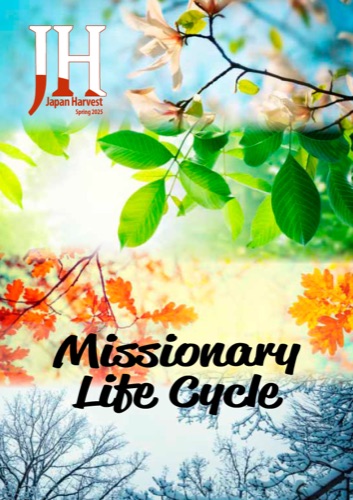
Spring · v76.2
The missionary life cycle
Wendy Marshall's editorial mapped the five stages of a missionary career; John Edwards traced thirty-plus years of shifting roles; Sue Plumb Takamoto's Fuller research put a number on adjustment — 7.8 years, on average, to feel at home in Japan. Judith Ricken described building "burnout prophylaxis" into KGK's culture; Shan Reed wrote on leaving mid-career; Jack Garrott on discerning a successor. New columns — Japanese Leader, Member Care, Missiology — debuted alongside.
"If the devil can't stop you, he will push you." — the warning Judith Ricken never forgot
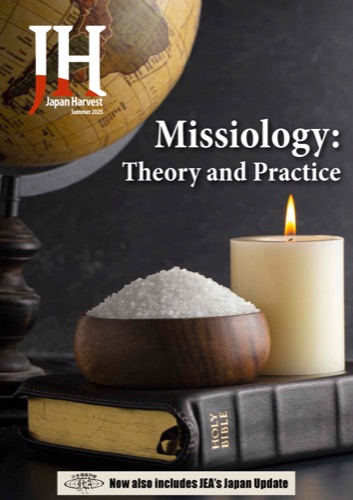
Summer · v76.3
Missiology, and a maturing institution
Biblical foundations of mission; Makito Matsuda's nine-step church revitalization framework from JEMA Connect; Niijima Jō as a model of the cultural mandate; Roger Lowther on ethnodoxology and a coming Tokyo arts-in-missions conference. The first issue to bundle JEA's Japan Update as a back section — and the one that reported JEMA at 1,221 missionaries across 46 agencies, up 236 in seven years.
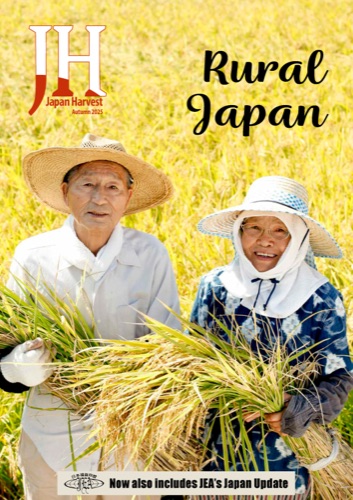
Autumn · v76.4
Rural Japan, the true frontier
Dawn Birkner's data identified 1,640 unchurched municipalities and argued for a pivot from established urban churches to unreached rural segments. Field reports from Obanazawa, Kumamoto, and Mie; from Iwate, word that 8 of 10 once-churchless coastal towns now have church plants, fourteen years after the triple disaster.
"This is my home. When God calls you somewhere, that place becomes your home." — Pastor Ester Wahrer, fifty years in Toyama
Taken together, 2025 reads as a community building for the long haul — tending its people, formalizing its infrastructure, and moving toward the places most easily overlooked.
Voices of the year
Aozora ga miete kita — I can see the blue sky.
I lived there for ten years as a missionary. We saw two people come to Christ, and I almost lost my family. I don’t recommend going there.
Every year since 1952 could read like this.
This page was drafted by machine-reading the full text of all four 2025 issues — a concept sample. The same process can produce a chapter for each of Japan Harvest's seven decades: the community's own story, told back to it.
Explore the archive →Concept sample: summaries drafted by AI from the complete OCR text of each 2025 issue, then lightly edited. Quotes are verbatim from the issues. Covers © Japan Harvest. Subject to JEMA editorial review before any publication.