Japan Harvest began the 1950s as a mimeographed newsletter counting missionaries, and ended it as the house organ of a movement that had counted itself, argued with itself, and begun to hand its work away. The through-line of the decade is that arc: from census to self-examination. What starts as an exercise in mapping — how many missionaries, in which prefectures, per how many unreached Japanese — matures into a sustained, often uncomfortable argument about method, money, and who should lead the Japanese church.
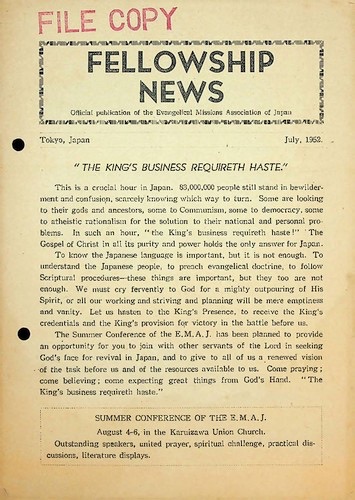
The opening years are pure organization. The inaugural 1952 issue reports 998 evangelical missionaries across 78 agencies, publishes prefecture-by-prefecture tables of population-per-church, notes that 24% of all Japanese Christians live in Tokyo, and reprints a National Tax Bureau ruling on missionary income tax. Its rallying cry is blunt — "Rural Japan needs the Gospel!" — a conviction drawn from the finding that churches existed in 93% of cities but just 2.3% of villages. Alongside the statistics came the scaffolding: a constitution, a statement of faith, ¥500 dues, comity surveys, the Karuizawa summer conferences, and guidance on the new Religious Juridical Persons registration law. A denominationally scattered force was building shared infrastructure before duplication set in, praying that "the Holy Spirit bind us all together in holy, aggressive love."
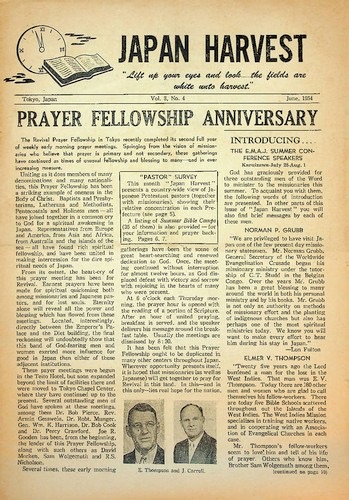
The middle years scaled the enterprise. By April 1954 the survey counted 1,507 missionaries; by 1957, 2,710 assigned to Japan. Radio broadcasts multiplied, the Every Home Crusade distributed 7.5 million tracts, Japan Christian College opened in 1955 with 108 students, and the 1955 literature survey catalogued 26 evangelical publishers. Billy Graham's February 1956 crusade filled Kokusai Stadium with 30,000 hearers. Yet even at the peak, an editorial voice worried aloud: "We have the fuel — but where is the fire?" The same issues that celebrated growth flagged neglected Shikoku, Gifu, and Kyushu, and ran symposia on missionary burnout and nervous breakdowns.
By 1956–58 the arguments had sharpened into the decade's real substance. Donald Hoke's essay on the indigenous church criticized missionary "colonialism" and shallow indigenous rhetoric alike; Charles Corwin's church-planting surveys showed a 25% drop in new churches from 1956 to 1957 despite more workers. The Japan Evangelistic Overseas Mission was founded at Hakone in 1956 — Japan pivoting from receiving missions to sending them, and Rev. Saburo Omori went to Formosa. Mark Maxey noted that only 1% of workers served Japan's 55% rural population. A. W. Tozer's warning about organizations that are "visible evidence of some men's fear and other's ambition" ran in a symposium on 143 overlapping agencies.
The Centennial year of 1959 brought both climax and audit: crusades in nine cities, 7,500 decisions at Osaka — and Max James's follow-up study finding that just 3 of 173 Otsu decisions were still attending a year later. Akira Hatori's call stands as the decade's summary demand: "In our 100th year, we Protestants must show oneness in Christ to the Japanese people!"
What the 1950s gave this community was the habit of honest accounting — the willingness to publish its own disappointing numbers next to its triumphs. That habit is JEMA's inheritance.
Voices of the decade
A Hindu said to me, ‘I’ll become a Christian if I ever see a Christian!’
I predict the next great world movement will be rising nationalism. If we abuse it, it will kill us. If we learn to use it, it will be the greatest force to carry out the great commission imaginable.
Every decade since 1952 could read like this.
This chapter was drafted by machine-reading the full text of every issue in the decade — a concept sample. The same process can retell all seven decades of Japan Harvest: the community's own story, told back to it.
Explore the archive →Concept sample: drafted by AI from the complete OCR text of each issue, then lightly edited. Quotes are verbatim from the issues. Covers © Japan Harvest. Subject to JEMA editorial review before any publication.